
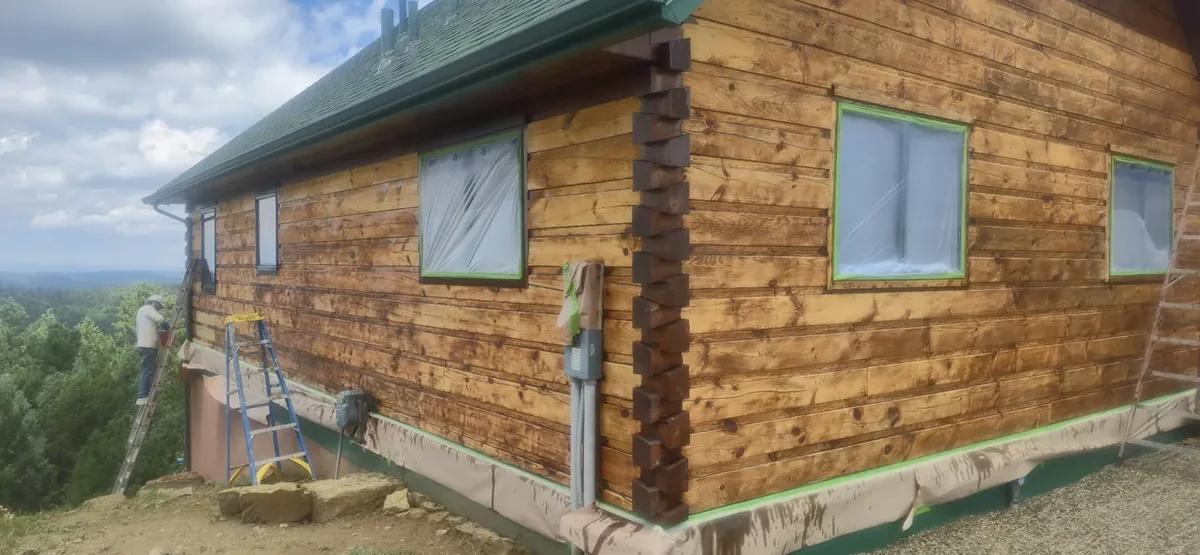
Most staining advice online is written about a two hundred square foot cedar deck. Out here a job is more likely to be four hundred feet of buck-and-rail, a loafing shed, a corral, and the south side of a barn that has not seen a finish since somebody's grandfather owned the place. The wood is rougher, the square footage is bigger, the budget per foot is tighter, and a good part of it is standing in dirt. Almost none of the deck-stain rules survive that contact intact.
Rough-sawn wood drinks about twice what you expect
This is the first thing that catches people out. A planed deck board has a closed, relatively smooth surface. Rough-sawn fence and barn lumber has an open, fibrous face with far more surface area, and it absorbs stain accordingly. Coverage rates printed on the can assume smooth wood. On rough stock you should plan on something closer to half of that, and on old, gray, weathered lumber that has been drying in the sun for a decade, less again.
Budget for it up front. The most common mistake we see on owner-applied fence jobs is buying to the label's coverage number, running short at eighty percent, and finishing the last run with a second product or a second batch that does not match. On a long fence line in flat light, that seam is visible from the road for years.
The upside of all that absorption is that rough wood holds a penetrating finish beautifully. It takes more material, but the stain gets deep into the fiber where it does the most good, and it wears by thinning rather than peeling.
Penetrating oil earns its keep on ranch wood
On decks there is a real argument between oil and modern waterborne products. On rough, wide, exposed ranch lumber the argument is narrower. Penetrating oil-based and oil-modified stains generally win here for three reasons.
- They move with the wood. Fence boards and barn siding swing through big moisture changes and cup and twist doing it. A penetrating finish has nothing to crack because there is no film sitting on top.
- They fail gracefully. When an oil finish wears out, it thins and fades. When a film finish fails on exposed lumber, it peels, and now you have a scraping job before you can re-coat.
- They handle rough texture. Waterborne products raise the grain, which on already-fibrous stock makes application fussier and the result inconsistent.
There is a real exception. Solid-body and heavily pigmented stains give the best UV protection and the longest color life, and on a barn you want to actually look red, that is often the right call. Just understand the tradeoff: the more film you build, the more you need the wood underneath to be dry when you coat it, because a heavy film over damp lumber traps moisture and you can rot a board from the inside while the outside looks perfect. On anything in ground contact or holding snow, we lean penetrating almost every time.
The post line is where everything actually fails
Walk any old fence and you will find the same pattern. The rails look tired. The posts look fine at eye level. And at the ground line, where the post meets the dirt, the wood is soft enough to push a screwdriver into.
That zone is a permanent moisture trap. It wicks groundwater up, it holds snow against the wood for months, and it stays shaded and slow to dry. No stain fixes that, and it is important to be clear about it: staining a fence is a UV and water-shedding treatment for the parts you can see, not a ground-contact preservative. The pressure-treated or naturally durable species in the ground is doing that job, or it is not.
What you can do is stop making it worse. Keep soil and mulch pulled back off the post where the grade allows. Cut back the grass and weeds that hold moisture against the base. When we stain a fence line we carry the finish down to grade rather than stopping at a tidy line six inches up, because that band is exactly where wind-driven rain hits hardest. And on a rebuild we will treat the buried portion and the end grain with a borate preservative before it ever goes in the hole, which is cheap insurance on a post you hope not to touch for twenty years.
End grain deserves the same attention everywhere else on the structure. Cut ends, rail tips, and the tops of posts absorb many times what a face grain surface does. A post top with a weathered, checked end soaking up every snowmelt is a rot column waiting to happen. Flood the end grain when you coat, and consider a cap on anything critical.
Prep on a structure you cannot pressure wash carelessly
Old ranch wood is often soft on the surface, and a pressure washer in the wrong hands will chew it into fuzz. We keep the pressure low and the tip moving, and on badly weathered barn siding we will sometimes skip the washer entirely in favor of a stiff brush and a wood cleaner.
The sequence that works on gray, oxidized lumber is straightforward. Clean it to remove dirt, mildew, and the dead gray surface fibers that no finish will stick to. Neutralize or brighten if the cleaner was caustic. Then, and this is the step that gets skipped, let it dry properly. On thick rough stock in our climate that is usually two to three dry days, longer after a real soaking. Stain into damp wood and the finish sits on the surface instead of penetrating, and it will not last a season.
You can check with a cheap moisture meter, or use the same water test you would use on a log wall: sprinkle water on the surface, and if it soaks straight in, the wood is dry and open and ready to take stain.
Timing and re-coat intervals at altitude
Our working season for this kind of work runs roughly from late spring through early fall, and the limits are the same ones that govern any exterior finish here: surface temperature, overnight lows, and whether the wood can dry between weather. Afternoon thunderstorms through July and August are a real scheduling factor on a fence line you cannot cover. There is more detail on that in our post about the southern Colorado exterior season.
As for how often, be realistic about what your wood is actually taking:
- Fence rails and boards, full sun: plan on a re-coat every three to four years with a penetrating oil. Two to three on a wind-scoured, wide-open site.
- Barn and outbuilding siding: often four to six years, longer on shaded or protected elevations and under a generous eave.
- Corral rails and anything livestock touch: shorter, because abrasion does as much damage as weather. Treat it as a wear surface.
- Solid-body and heavily pigmented finishes: five to eight years on vertical siding, but with a real prep obligation when they finally do go.
The good news is that a penetrating finish on rough wood is one of the easiest things in this trade to maintain. There is no stripping, no scraping, and usually no sanding. Clean it, let it dry, and put another coat on. The job gets cheaper every cycle you stay ahead of it, which is the same economics that governs wood staining and refinishing generally.
What we actually do on these jobs
Most ranch work around Gardner, Aguilar, and out toward the Huerfano valley is sprayed and back-brushed. Spraying alone on rough wood leaves the stain sitting in the texture rather than driven into it, so the brush behind the gun is what makes the coat last. It is slower, and it is the difference between three years and five.
We price these by the linear or square foot once we have seen the condition, because the spread between "cleaned and coated" and "cleaned, repaired, and coated" is wide on old lumber. If you have boards that need replacing before anything gets stained, that is a conversation worth having up front rather than discovering it on day two.
Got a fence line, a barn, or a set of outbuildings that need attention? Tell us the rough footage and we will come look at what you actually have before quoting a number.