
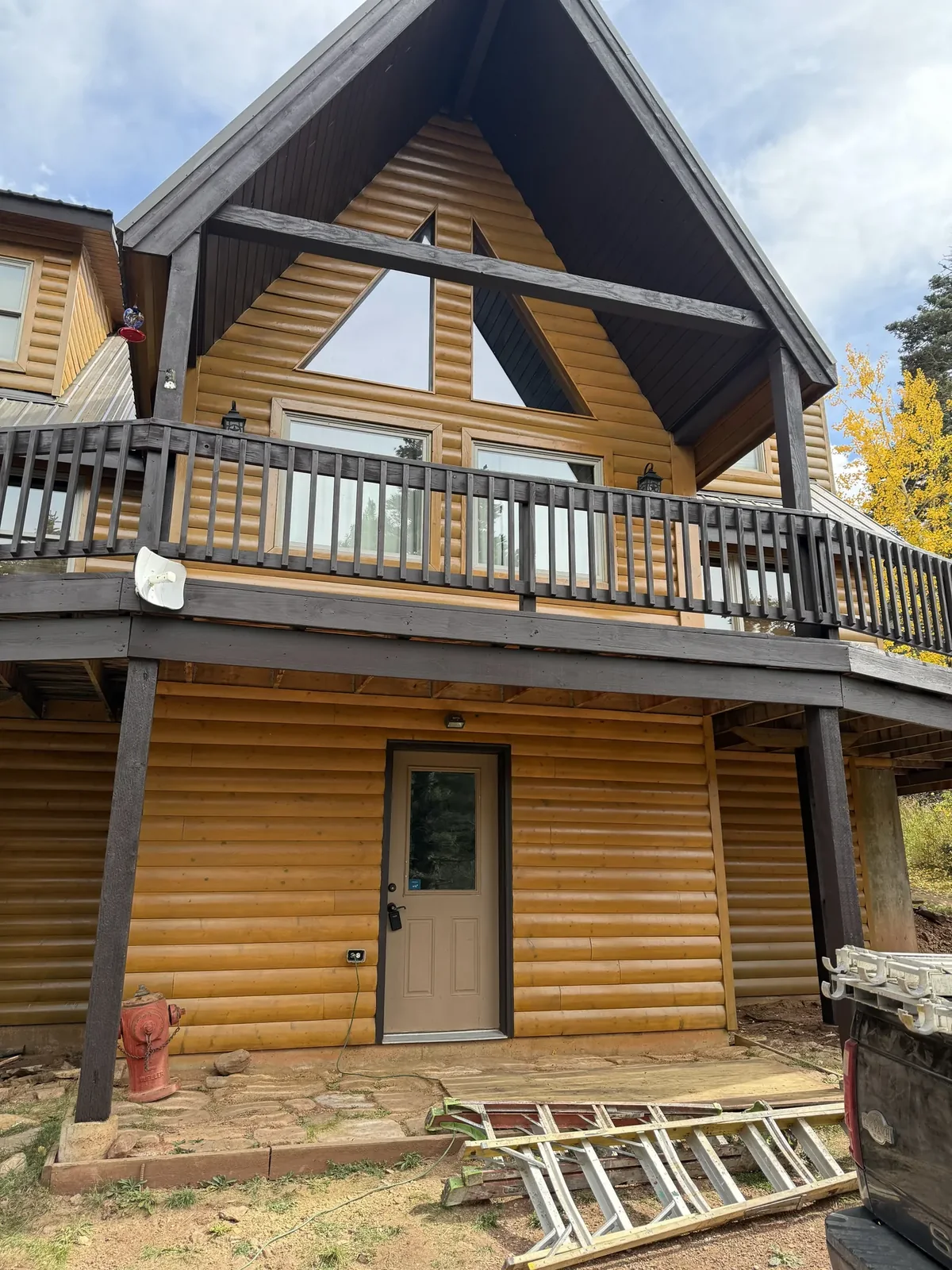
It is the question we hear most from log home owners around Walsenburg and Huerfano County: how long until I have to do this again? The honest answer is that a good coat lasts anywhere from three to eight years up here, and where your home lands in that range comes down to a handful of factors you can actually see and control. Let's break down what drives the interval so you can plan (and budget) instead of guessing.
Why one wall wears out before the others
Log homes almost never fail evenly. The south and west walls take the brunt of the sun and the wind-driven weather, and they can lose their finish in half the time of a shaded north side. It is completely normal to touch up the sunny elevations on a shorter cycle while the protected walls ride along for years more.
So the useful question is not "how often should I restain the house?" but "how often does this wall need it?" Walk the perimeter and judge each elevation on its own. When we quote a maintenance coat, we often recommend hitting only the south and west faces. There is no sense in stripping and recoating timber that is still doing its job.
Typical intervals by exposure
- South and west walls: every 3 to 4 years for a maintenance coat in full mountain sun.
- East walls: roughly 4 to 6 years, since morning sun is gentler than afternoon heat.
- North and shaded walls: often 6 to 8 years, sometimes longer under a deep overhang.
Treat those as starting points, not promises. A home fully exposed on a ridgeline will run to the short end; one tucked into the trees will stretch to the long end.
Stain type changes the math
The product on your walls matters as much as the weather. Log finishes fall into two broad camps, and they age very differently.
Film-forming vs. penetrating stains
Film-forming systems build a tough, breathable layer on the surface. They give the longest stretch between full recoats and the most uniform color, but when they finally go, they tend to need more prep to remove. Penetrating stains soak into the wood and wear by gradually thinning rather than peeling. They may ask for attention a little sooner, but the next coat is usually a straightforward wash-and-brush. Neither is "better." What matters is knowing which one you have so you re-coat on its schedule, not someone else's. There is a fuller comparison on our log home restoration page.
Elevation and UV speed everything up
At six thousand feet and higher, the sun is measurably more intense than it is down on the plains, and UV is the single biggest enemy of a log finish. Every extra thousand feet of elevation and every hour of unshaded exposure shortens the interval. That is why the same stain that lasts eight years on a shaded cabin in the trees might need a refresh in three on a wide-open home catching afternoon sun off the Spanish Peaks. Colorado's high country is simply harder on wood than most product labels assume.
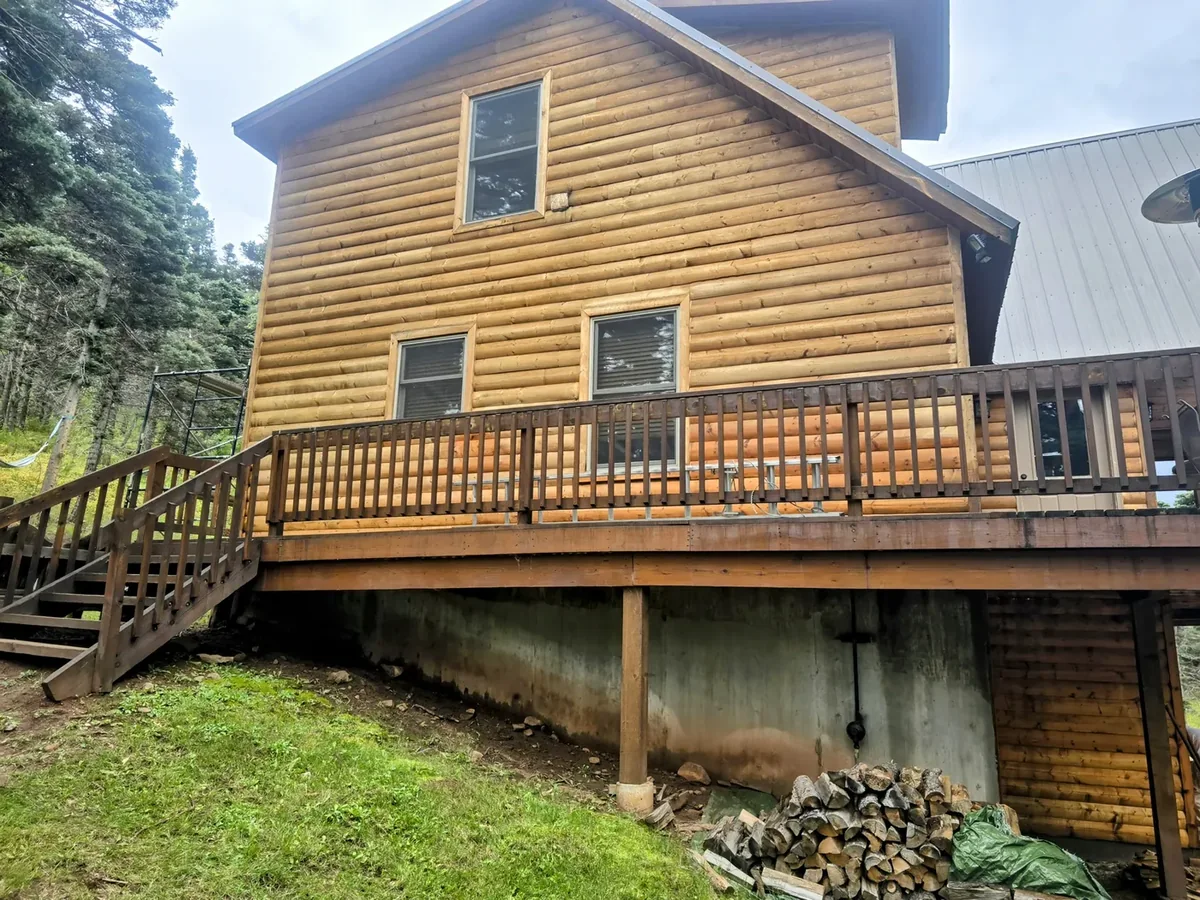
The water-bead test tells you it's time
You don't have to track dates on a calendar. Your logs will tell you. The simplest check in the book: on a dry day, splash a cup of water on a sun-facing wall and watch. If it beads up and rolls off, the sealant is still working and you can wait. If it soaks in and darkens the wood, the finish has worn through and moisture is now reaching bare timber. That is your signal to schedule a coat before real damage starts. Do this test every spring on the south and west walls and you will rarely be caught off guard. For the full checklist of red flags, see our post on the signs a log home needs restoration.
Maintenance coat vs. full restoration
Re-staining on schedule is cheap insurance. A maintenance coat (wash, let it dry fully, spot-repair any chinking, and brush on a fresh coat of the same product) keeps the protective system intact and costs a fraction of the alternative. Skip it too long, though, and the wood grays, checks open up, and water gets in. At that point you are no longer re-staining; you are looking at a full restoration: blasting back to bare wood, borate treatment, new chinking, and a rebuilt multi-coat finish. The whole point of staying on top of the interval is to keep your home in the inexpensive-maintenance lane. If it has already slipped, our step-by-step restoration guide walks through what that bigger job involves.
Good prep buys you years
Here is the part that gets skipped: how long a coat lasts is decided before the stain ever goes on. Clean, dry, properly prepped wood holds a finish dramatically longer than a coat rushed over dirt, mildew, or a still-damp wall. Blasting or sanding back to sound fibers, letting the logs dry to the right moisture level, and applying full, even coats is exactly what stretches a three-year wall into a five-year wall. Cut the prep and you will be back on a ladder twice as often. That is why we never treat prep as the optional part of the job. It is the part that sets your next re-stain date.
Related services
Most re-stain projects touch a few related jobs. We handle log home restoration from full blast-and-restain down to seasonal maintenance coats, along with chinking, caulking, and the deck and exterior wood that usually needs attention on the same visit. If you are not sure whether your walls need a quick coat or the full treatment, that is exactly what a walkthrough sorts out.
Want a straight answer for your home? Send us a few photos or request a free estimate and we will tell you honestly how much life is left in your finish and when to plan the next coat.